
Why Colour Affects Our Mood?
The Science of Feeling Blue (and Why Red Makes You React.)

Prefer to listen?
In today's Five Whys, we examine how colour affects our mood, decisions, and well-being.

Have you ever noticed that you feel calm in an environment that is coloured a certain way - such as blue? You may have felt energised when surrounded by red. Colour has the power to change how we think and how we feel. It can motivate us, help build trust and even make us happy.
Depending on the setting, colour can convey different emotions. If used positively, blue can make us feel calm and build loyalty and security. Yet, if used negatively, it might convey sadness, coldness, and depression.
Colour Psychology goes back to Sir Isaac Newton, who, in 1666, discovered that white light splits into colours when shone through a prism. In the 19th Century, Johann Wolfgang von Goethe published a book—"Theory of Colors"—that explained the nature of colour and its effects on people. Since then, there have been further studies, and colour is even now used as therapy because of its ability to affect our bodies.
So why is this, and why do colours affect our mood? Let's look into this more in today's Five Whys.
Why #1: Why does colour affect your decisions?
As mentioned, we often notice that colours influence our feelings and actions. For example, yellow might make us happy and joyful, while red might make us feel excited and confident. As a result, different sectors use colour to help us make decisions. Marketing uses colour to evoke specific emotions and encourage purchases. Meanwhile, interior designers use colour to create a desired atmosphere. Simply put, colours aren't just visual stimuli; they have a tangible impact on our behaviour.
Why #2: Why do we feel differently when seeing different colours?
Our emotional responses to colour aren't purely rational. Emotional response to colour is rooted in a combination of factors: learned associations (like red meaning "stop" from traffic lights) and, more importantly, deeply ingrained, often subconscious, physiological responses. These physiological responses are linked to heart rate, hormone release, and pupil dilation. For example, warm colours (red, orange, yellow) increase heart rate and stimulate the sympathetic nervous system, while cool colours (blue, green) are calming.
Why #3: Why are these feelings similar across different cultures?
Consistency across cultures might suggest more of a biological basis than a learned behaviour. While cultural nuances do exist (for example, the symbolism of specific colours varies), the fundamental physiological responses – the tendency for red to evoke excitement or danger and for blue to be calming – are remarkably similar across diverse populations. This points to an evolutionary origin rather than through learning. Early humans who quickly associated specific colours with danger (e.g., the red of blood or a poisonous berry) or safety (e.g., the green of vegetation) had a survival advantage. These associations were then passed down through generations, becoming hardwired into our brains.
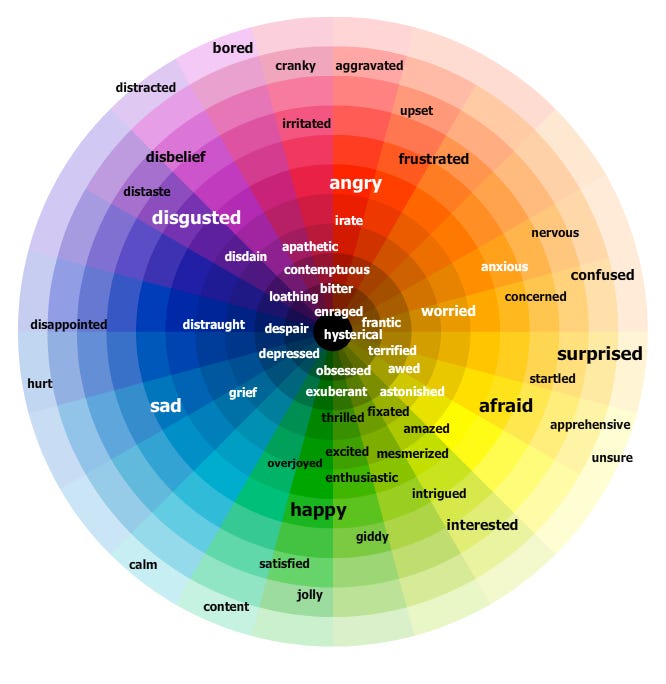
Why #4: Why was it important for our ancestors to react quickly to colours?
It's all about speed and survival. With the world filled with potential threats and scarce resources, quickly assessing an environment was critical for survival. Colours provided immediate visual cues. Those who could promptly interpret these colour cues were more likely to avoid danger, find food, and reproduce, passing on their ability to interpret colour to their offspring. This created selective pressure favouring individuals predisposed to associate certain colours with specific outcomes.
Why #5: Why do these reactions happen without you even thinking about it?
Your brain doesn't have time to analyse every single thing you see. It needs to react quickly - just like Fight, Flight, or Freeze gets you out of danger. So, the brain has shortcuts – automatic responses to colours before you consciously register them is one of them. These shortcuts are managed by parts of your brain like the amygdala (which deals with emotions) and the hypothalamus (which controls things like your heart rate). This is why you might feel a sense of urgency when you see red, even before you realise why.
In Summary...
Colour makes us feel certain because of an evolutionary shortcut in our brain that helps us survive. To enable us to react quickly in the wild, our ancestors could quickly associate danger with red and green with resource gathering and a sense of balance and harmony because of its association with nature. It is true that over time, we have learned that some colours mean certain things, like red for stop - a commonality across cultures reinforces the idea that reaction to colour is more hardwired into us. The more we learn about the impact of colour on us has led to using colour for therapy. We now know that red can increase our heart rate and excite us, yellow can make us happy and stimulate the nervous system, keeping depression at bay, and indigo can relieve headaches and migraines.
Next time you catch yourself being aware of colour in your surroundings, take a pause to be in the moment and see how it makes you feel, or maybe take it a step further and work out how you can incoropate colour to enhance spaces for creativity, or surround yourself with green and blue when you are feeling stressed.
Thank you for reading. Stay curious. Please like, subscribe, and comment to stay updated on my latest articles.
Matt